|
|
|
|
|
|
|
|
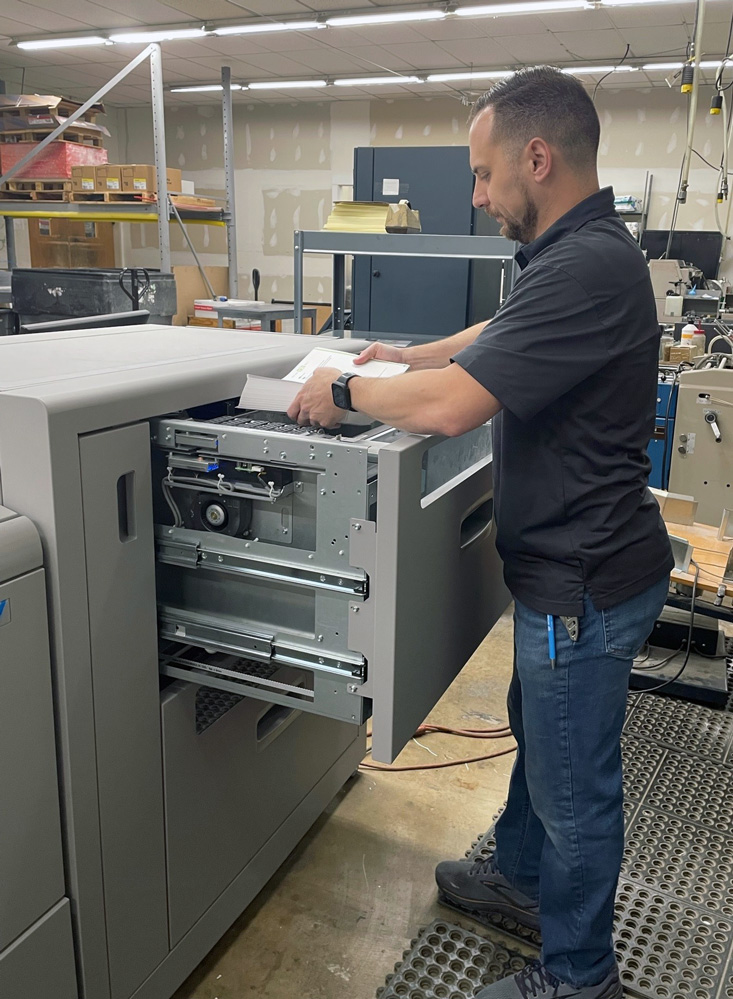
PRODUCT OF THE WEEK: Watkiss DigiVAC(This article appeared in PrintWeek Magazine on 26th October 2001, and is reproduced with permission of Haymarket Publishing.)Karen Charlesworth takes a closer look at the world's first top-loading, bottom feeding, continuous-running vertical tower collatorThe virtues of vertical tower collators are many and various. Space-saving, check; cheap, check; fast, check; lots of bins, check; expandable, check - and so the list goes on. But one virtue of which vertical collators are manifestly not possessed is continuous running - the ability to add more sheets to a bin before it runs out. But now there's a solution in the shape of Watkiss' new DigiVAC, in development for two years, shown as a prototype at Drupa last year and formally launched at Print UK in September. Watkiss' qualifications to solve the continuous-run problem couldn't be better. The company's corporate mantelpiece is already decorated with two British Design Council awards: one in 978 for the WA25 rotary collator and another in 1992 for the Vario, the collator that allowed the addition of single bins and the mixing of suction and friction feeds in a single tower. Sales director Paul Attew is enthusiastic about the DigiVAC's potential to win similar plaudits: "This really is a machine to turn collating on its head," he puns. All existing vertical collators feed from the top of the pile, which means they have to be stopped for reloading - an exercise which, on a 10-bin machine, can take the same number of minutes. In fact, the average tower collator has such a high speed, coupled with such a comparatively shallow bin, that loading has become a big problem: a load-time of, say, six minutes, yields a run-time of just five. In extreme cases, this can slash the machine's productivity by up to two-thirds. Vertical collators have traditionally solved the problem of continuous running with the so-called multiple bin approach: adding extra bins, together with an automatic switching system that, on running empty in the first bin, switches pick-up to the second nominated bin, and then back to the first again when the second runs out. But as Attew points out, this is only a partial solution: "It isn't truly unattended running - it just lengthens the time till the Watkiss DigiVAC first operator intervention, because it's picking up from two consecutive bins. But once that grace period is over, the operator is still loading each tower in turn, pretty much continuously." Reloading empty bins always runs the risk of putting the wrong sheet in the bin, a mistake which, according to Attew, happens frequently. And of course, using the multiple- bin solution means the expense and floorspace of an extra tower. Achieving bottom-feed Watkiss explored various ways to achieve the bottom-feed goal, and the result is pretty simple: it's basically a feeder from the SlimVAC collator (Watkiss' super-slim stackable tower) turned upside down. The pile in the bin floats on an airbed; a vacuum chamber pulls the bottom sheet down and drives it forwards into the grips. It's a non-contact feed system, which has other advantages: it won't mark delicate stocks, and particularly interesting for digital printers, it won't scuff toner-based digitally printed jobs. The bottom feed also makes for speedier set-up: unlike a conventional vertical collator, where the pile height diminishes in front of a fixed feeder and therefore needs to be raised to keep the pile/feeder relationship constant, the airbed always presents the sheet to the feeder at the right height - as a consequence, setting up the collator involves no fiddling with tray height, separation and vacuum controls. The paper transport path on the DigiVAC is also different from that on a normal vertical collator, although this has more to do with plans for ergonomic stacking than with the DigiVAC per se: as the sheet leaves the bin, it's delivered upwards over a drum and along a straight path into any downstream finishing equipment. The benefit of this is that an extended period of flatness for the set means less distortion and hence fewer jams in whatever you have attached. Another benefit of bottom-feed, Watkiss argues, is that loading is less stressful. "The bins that are at waist height - the optimum level - are only perhaps two out of eight or ten, which means you're stretching or bending with a heavy slab of sheets to get to the others," Attew points out. "With the DigiVAC, you can put a little bit in at a time." Installing a DigiVAC isn't going to save operator wages: you're still going to need a speedy pair of hands to keep the machine fed. But if you were considering going the multiple-bin route, a DigiVAC will save you the capital outlay and floor space of an additional tower. And it will cut out machine stoppage time, which is arguably more crucial. Attew calls it "a tortoise and hare race", his point being that the DigiVAC (that's the tortoise) wins the race by keeping going at a steady speed, rather than the other collators' hare-like bursts followed by stops. It works out like this: take an ordinary vertical collator running at an average 6,000 sets per hour, or 100 sets per minute. If it can pack 450 sheets into a bin (a height of around 50mm), that's a running time of five minutes and a potential loading time of three minutes, making the load/run cycle time eight minutes in all. For the hourly production rate, divide 60 by the load/run cycle time of eight minutes, and multiply it by the number of sheets in the bin (450), and you get the Above: adding paper princely sum of 3,375 sets per hour: a little more than a half of the collator's actual speed. Set this against the DigiVAC, with a speed of 3,500 sets per hour: that number is what it actually delivers. Small- to medium-sized general commercial printers are Watkiss' main target for the DigiVAC: the two beta users are Nightingale Press in Royston and Prontaprint in Barking. But the company is also targeting digital printers, because the airbed and vacuum chamber arrangement is "ideal" for delicate stocks. The DigiVAC is available in towers of eight bins only (note that you can't buy individual bins as with Watkiss' SlimVac and Vario collators) with additional extension modules of four bins. At present you can't link towers together, but Attew says this is in the pipeline. It's good value for money: the continuous loading feature makes it potentially worth more to a smaller printer than a two-tower conventional- loader, and yet an eight-bin DigiVAC costs less than all of the conventional- loaders. |
|
|
|